
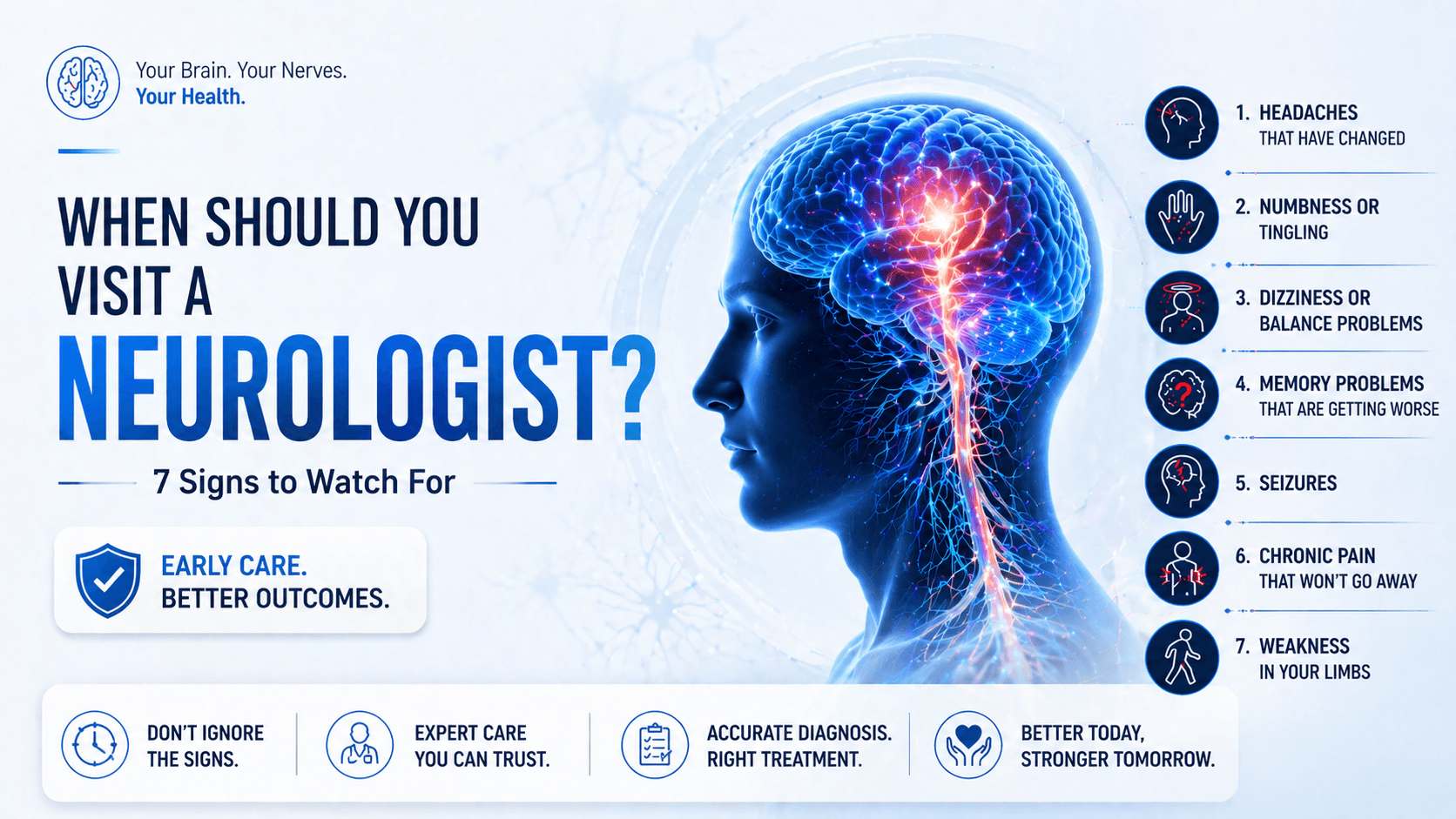
When should you visit a neurologist? 7 signs to watch for
Introduction
A neurologist is a doctor who specialises in problems related to the brain, spinal cord, and nerves. Most people have never visited one, and many are not sure when they should.
The short answer: when something is happening with your body that you cannot explain, and it involves your head, your balance, your movement, or your ability to think clearly. These are not always dramatic events. Sometimes it is a headache that will not go away. Sometimes your hand goes numb for no reason. Sometimes you keep forgetting things and it is getting worse, not better.
Here are 7 situations where you should see a neurologist instead of waiting it out.
7 signs it is time to see a neurologist
1. Headaches that have changed
Everyone gets headaches. That is not the concern. The concern is when your headaches change. They are more frequent than they used to be. Or more intense. Or they come with visual disturbances, nausea, or sensitivity to light that you did not have before.
New headaches after age 50 should always be evaluated. A headache that wakes you from sleep is not normal. A headache that gets worse when you cough, sneeze, or bend over needs attention. These patterns do not always mean something serious, but a neurologist can rule out the things that are.
2. Numbness or tingling that keeps coming back
Your foot falls asleep because you sat on it wrong. That is circulation. But if numbness or tingling shows up without an obvious cause, especially on one side of the body, or if it comes and goes repeatedly, it could signal nerve damage, a pinched nerve, or something affecting the central nervous system.
Carpal tunnel syndrome causes tingling in the hands. Diabetic neuropathy causes it in the feet. Multiple sclerosis can cause it almost anywhere. The pattern and location tell a neurologist a lot about the cause.
3. Dizziness or balance problems
Feeling lightheaded when you stand up quickly is usually a blood pressure issue. But true vertigo, where the room spins, or persistent balance problems where you feel unsteady on your feet, can indicate inner ear problems, brainstem issues, or neurological conditions.
If you are bumping into things, having trouble walking in a straight line, or feeling like the ground is moving under you, that is your nervous system asking for help.
4. Memory problems that are getting worse
Forgetting where you put your keys is human. Forgetting what keys are for is a different conversation.
The distinction matters. Normal age related memory changes are slow and minor. You occasionally forget a name, you walk into a room and forget why. But if you are losing track of conversations, repeating the same questions, getting confused about familiar routes, or if your family has started noticing changes you have not, that warrants investigation.
Not all memory problems are dementia. Thyroid issues, vitamin deficiencies, sleep disorders, and depression can all cause cognitive changes that are reversible once treated. A neurologist can sort out what is going on.
5. Seizures
If you have had a seizure, you need a neurologist. Full stop. Even if it happened once and has not happened again.
Seizures are abnormal electrical activity in the brain. They can look like dramatic full-body convulsions, but they can also be subtle: brief episodes of staring, confusion, or repetitive movements like lip smacking or hand rubbing. If someone described an episode to you that you do not remember, take it seriously.
6. Chronic pain that does not respond to treatment
Pain is your nervous system sending a signal. Sometimes the signal keeps firing even after the original cause is gone. Nerve pain feels different from muscle pain. It tends to be burning, shooting, or electric. It follows nerve pathways. And it does not respond well to regular painkillers.
Conditions like sciatica, trigeminal neuralgia, and post-herpetic neuralgia (pain after shingles) are neurological. So is chronic migraine. If you have been dealing with pain for months and nothing seems to help, a neurologist may approach it differently than your general physician.
7. Weakness in your limbs
If your grip is weaker than it used to be, if you are dropping things more often, if one leg drags slightly when you walk, these are not things to write off as getting older. Gradual weakness can indicate nerve compression, motor neuron disease, or myopathy.
Sudden weakness, especially on one side of the body, is a medical emergency. That could be a stroke. Call an ambulance immediately.
What happens during a neurology consultation
A neurologist will ask detailed questions about your symptoms: when they started, how they have changed, what makes them better or worse. They will do a physical exam testing your reflexes, coordination, sensation, and strength.
Depending on what they find, they may order tests: an MRI or CT scan of the brain, nerve conduction studies, an EEG to look at electrical activity, or blood work. These help narrow down the diagnosis.
At Trinity Hospital Bhopal, our neurology department handles everything from chronic headaches to complex neurological disorders. If you are not sure whether you need a neurologist, start with a consultation. Book an appointment — it is better to check and find nothing than to wait and find something that has progressed.
Frequently asked questions
Can I go directly to a neurologist or do I need a referral?
In India, you can consult a neurologist directly without a referral. If your symptoms are neurological, going straight to a specialist saves time. At Trinity Hospital, walk-in consultations are available. See our doctors.
Are headaches always a neurological problem?
Not always. Stress headaches and sinus headaches are common and usually managed by a general physician. But if headaches are frequent, worsening, or come with other symptoms like vision changes or vomiting, a neurologist should evaluate them.
What is the difference between a neurologist and a neurosurgeon?
A neurologist diagnoses and treats neurological conditions with medication and therapy. A neurosurgeon operates. Many patients see a neurologist first, and only get referred to a neurosurgeon if surgery is needed.
Is memory loss always Alzheimer's?
No. Memory changes have many causes, including thyroid disorders, vitamin B12 deficiency, depression, sleep apnea, and medication side effects. Many of these are treatable. A neurologist can determine what is behind the changes.
Conclusion
Most neurological problems are more treatable when caught early. The longer you wait, the less a doctor can do. If something about your headaches, memory, balance, or sensation has changed and it is not going away, do not Google your symptoms for another month. See someone who can actually run the right tests.
Call Trinity Hospital Bhopal at +91-9109182424 to book a neurology consultation. Our neurology and neurosurgery departments work together, so if something more is needed, the pathway is already there. You can also contact us online.